Beyond Keywords: Search That Understands
Traditional search is frustrating. Type “warm coastal retirement” and you might get results for places that happen to contain those exact words—or nothing at all if the description says “sunny beachfront community perfect for retirees” instead.
Semantic search changes that equation entirely. It understands what you mean, not just what you typed. The platform’s semantic search finds relevant results even when the exact words don’t match, because it’s looking at meaning, not characters.
How It Actually Works
When you search for “warm coastal retirement,” the system doesn’t scan for those three words. Instead, it converts your query into a mathematical representation of its meaning—a vector in high-dimensional space. Every county, broker, and agent in the system has already been converted to their own vectors based on their descriptions and characteristics.
The search finds results whose meaning-vectors are closest to your query’s meaning-vector. A county described as “sunny beachfront community with mature neighborhoods and low property taxes” will surface as a strong match—because semantically, it’s describing the same thing you’re looking for.
This isn’t magic; it’s mathematics. But the result feels like talking to someone who actually understands what you’re asking.
Managing the Search Infrastructure
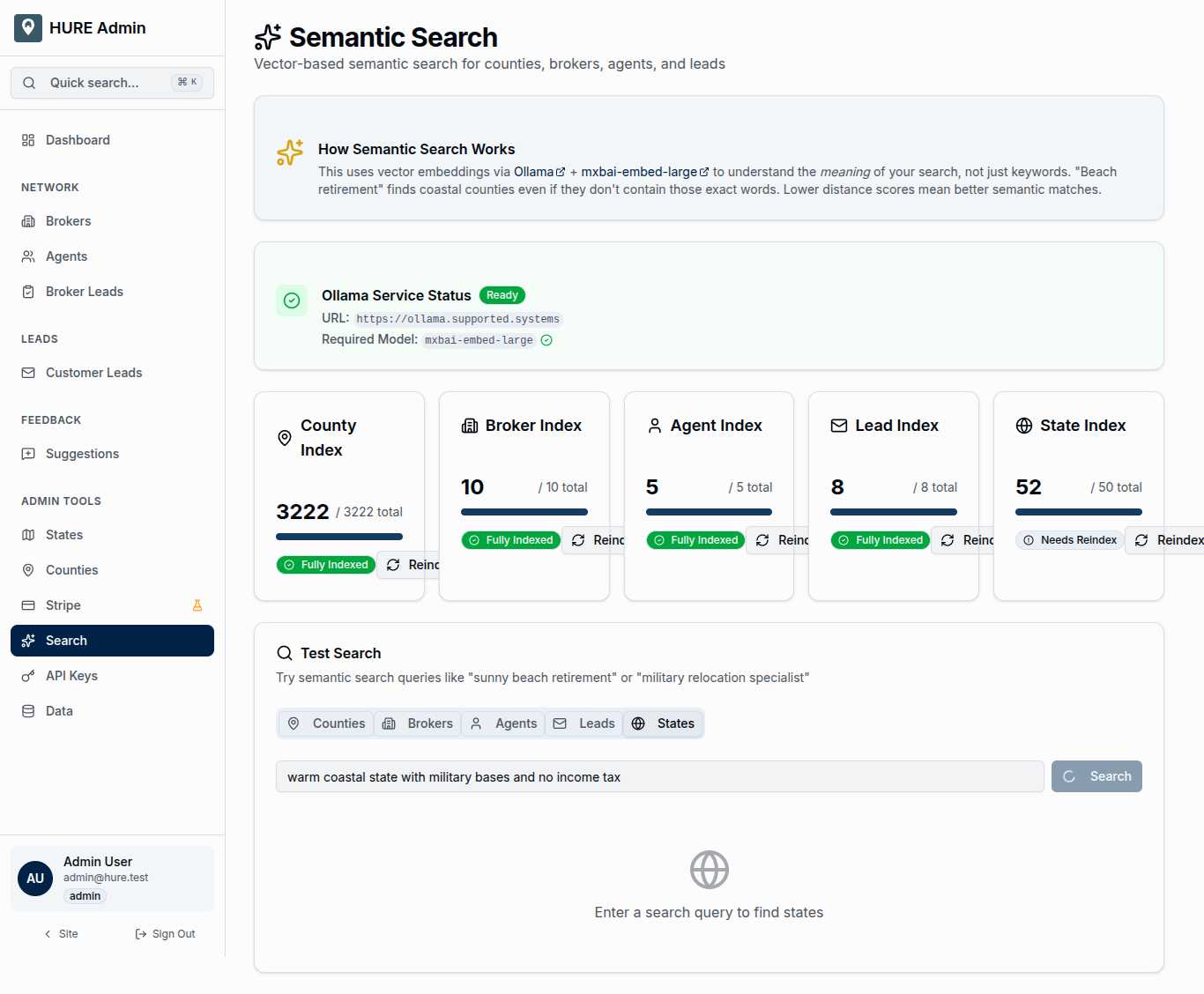
The Search administration page gives platform administrators full visibility into how the semantic search system is performing:
Ollama Service Status shows whether the AI model powering embeddings is online and healthy. A green “Ready” indicator means searches will return intelligent results. If the service is unavailable, the system falls back to traditional search.
Index Management displays five separate vector indices—one each for Counties, Brokers, Agents, Leads, and States. For each index, you can see:
- How many records are currently indexed versus how many exist in the database
- A progress bar showing indexing completeness
- Whether the index needs refreshing (perhaps after bulk data updates)
- A one-click reindex button to rebuild the vectors
When new counties are added or broker profiles are updated, the corresponding indices may need refreshing to ensure searches return current data. The dashboard makes that obvious and actionable.
The Power of Natural Language
The test search interface lets administrators (and eventually users throughout the platform) search using plain English:
For counties:
- “warm state near air force base with good schools”
- “affordable midwest communities with low crime”
- “mountain skiing areas with year-round activities”
For brokers:
- “military relocation specialists”
- “luxury home experts in coastal areas”
- “first-time buyer focused brokerages”
For agents:
- “Spanish-speaking agents in Texas”
- “veterans helping veterans”
- “agents specializing in ranch properties”
Results appear ranked by semantic relevance. A score tells you how close each result is to your query’s meaning—lower distance means better match. This ranking helps you understand not just what matched, but how well it matched.
Why This Matters for Families
Imagine a family with PCS orders to somewhere they’ve never been. They don’t know county names or specific neighborhoods. They know what they want: “somewhere with good schools, reasonable commute to base, and outdoor activities for kids.”
Traditional search can’t help them. They’d have to browse through 3,222 counties one by one, reading descriptions and hoping to find something that fits.
Semantic search lets them describe their ideal community in their own words and surfaces the counties that match—even if those counties describe themselves differently than the family would have guessed.
That’s the difference between a search engine and a discovery tool. One finds what you asked for. The other finds what you’re looking for.
The Technology Behind It
The semantic search system uses Ollama with the mxbai-embed-large model to generate embeddings. Each piece of text—whether it’s a county description, a broker bio, or a customer inquiry—gets converted to a 1024-dimensional vector.
Those vectors live in sqlite-vec, a lightweight vector database that performs similarity searches with remarkable efficiency. When you search, your query gets embedded in real-time and compared against pre-computed vectors using cosine distance.
The result: sub-second searches across thousands of records, returning results ranked by semantic similarity rather than keyword frequency.
Keeping Search Fresh
Content changes. Counties update their descriptions. Brokers refine their specializations. New agents join the network. For semantic search to remain accurate, the vector indices need to reflect current data.
The reindex buttons on this page trigger background jobs that regenerate embeddings for each entity type. For most updates, this happens automatically. For bulk changes or system recovery scenarios, manual reindexing ensures the search reflects reality.
Search That Grows Smarter
As the platform adds more content—richer county descriptions, more detailed broker profiles, better state information—the semantic search automatically becomes more valuable. Every piece of descriptive text becomes searchable by meaning.
This isn’t just a feature. It’s a fundamental shift in how families discover their next hometown. Instead of hunting through lists and filters, they can simply describe what they’re looking for.
And the platform understands.