When Things Go Wrong, We’re Still Here
Nobody plans to land on an error page. You clicked a link, typed a URL, or followed a bookmark—and instead of finding what you expected, you hit a dead end. It happens to everyone, and how a website handles it says a lot about how much they care about your experience.
At Hometown USA Real Estate, even our error pages are designed to help you get back on track.
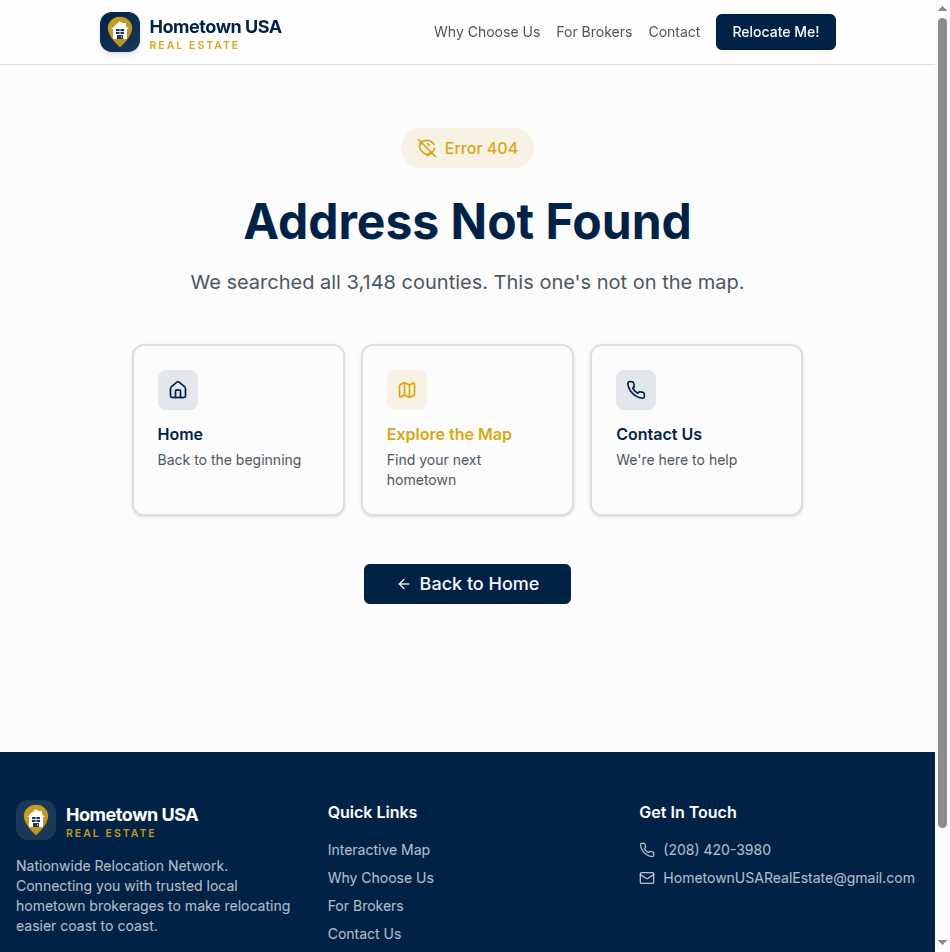
The 404: Address Not Found
When you try to visit a page that doesn’t exist, you won’t see a generic “Page Not Found” message. Instead, you’ll find something more… on-brand.
“Address Not Found” — because we’re in real estate, after all.
“We searched all 3,222 counties. This one’s not on the map.” — a gentle acknowledgment that something went wrong, delivered with a wink.
Rather than leaving you stranded, the page offers three clear options:
Home takes you back to the beginning. Sometimes starting over is the best path forward.
Explore the Map sends you to our interactive county map. If you were looking for a specific location, maybe the map will help you find it.
Contact Us opens a line to our team. If you believe you should have found something and didn’t, we want to know.
A prominent “Back to Home” button sits front and center, making the most common next step obvious and immediate.
The 500: Something Went Wrong
Server errors are different. The page exists—something just broke along the way. When that happens, the error page acknowledges the problem honestly:
“Something Went Wrong” — no technical jargon, no confusing codes.
“Our team has been notified and is working on it.” — because you shouldn’t have to report the problem yourself.
A retry button offers an easy path: maybe it was a momentary glitch, and refreshing will get you where you wanted to go. If not, the same navigation options are available to help you continue your journey elsewhere on the site.
Why Error Pages Matter
It’s tempting to treat error pages as an afterthought—something you throw together because the framework requires it. But consider this: a family researching their relocation, already stressed about moving across the country, clicks a link and hits a dead end.
A generic error message adds frustration to an already complicated process. A thoughtful error page says, “We see you. Something didn’t work. Here’s how to keep moving.”
That small gesture of care reflects the same philosophy behind everything we build. Families relocating to new communities deserve thoughtful guidance at every step—even the unexpected ones.
Design That Matches
Error pages use the same visual language as the rest of the site:
Navy headers maintain brand consistency. You haven’t left Hometown USA Real Estate; you’ve just hit a bump.
Gold accents draw attention to important elements—buttons, icons, calls to action.
Clean typography keeps messages readable and approachable.
Full navigation remains available. You’re not trapped on the error page; every path through the site is still accessible from the header and footer.
Real Estate Themed Messaging
The language choices aren’t accidental. “Address Not Found” resonates differently than “Page Not Found” when you’re a real estate platform. “We searched all 3,222 counties” reminds visitors of the platform’s scope while playfully acknowledging the error.
These small touches transform a frustrating moment into something memorable—maybe even slightly amusing. And when you’re building trust with families making major life decisions, every interaction counts.
Accessible to Everyone
Error pages are built with accessibility in mind:
Semantic HTML ensures screen readers convey the message clearly.
Keyboard navigation lets users tab through options without needing a mouse.
High contrast keeps text readable for users with visual impairments.
Clear button labels describe exactly what each action does.
An error shouldn’t become a barrier. Everyone deserves a clear path forward.
The Rare Moments
Hopefully, you’ll never see these pages. The goal is smooth navigation, fast loads, and everything working exactly as expected. But when the unexpected happens—a mistyped URL, a moved page, a server hiccup—the error page is there to catch you.
Even our dead ends lead somewhere useful.